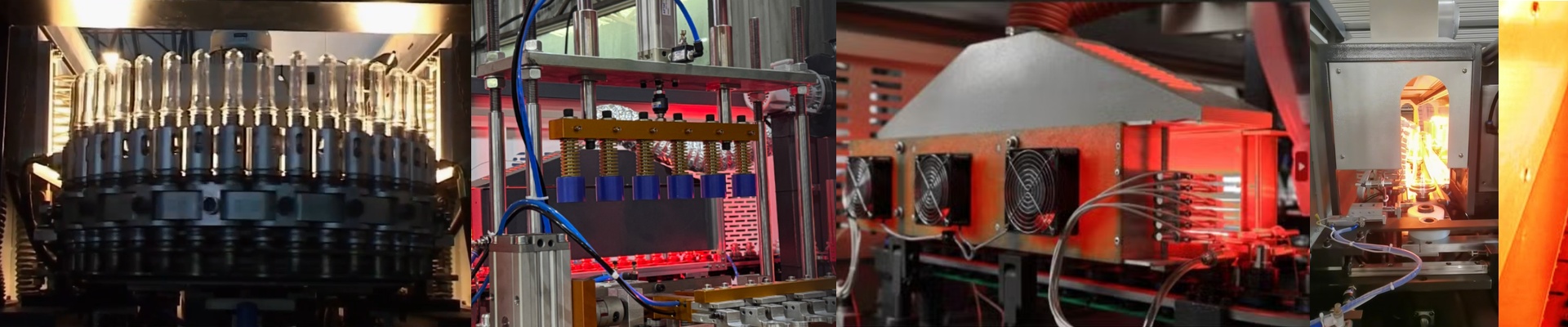
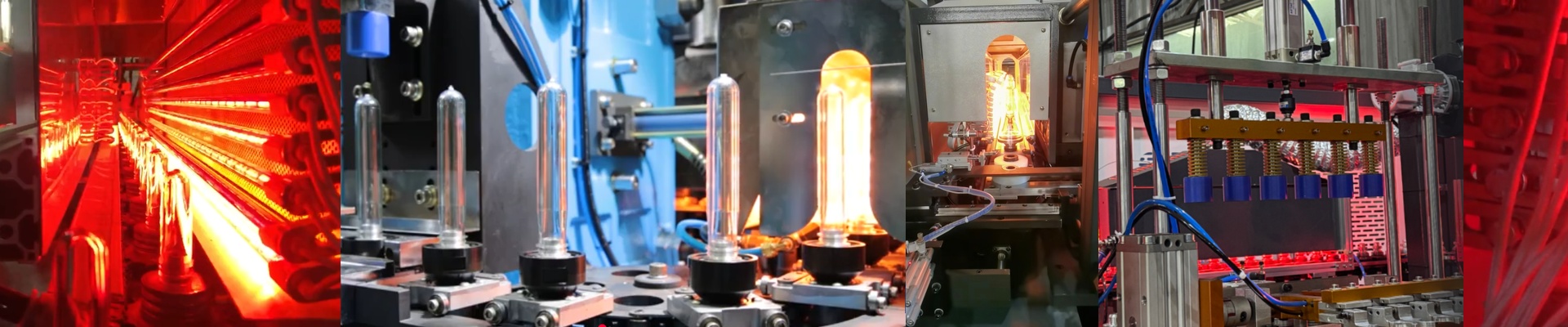
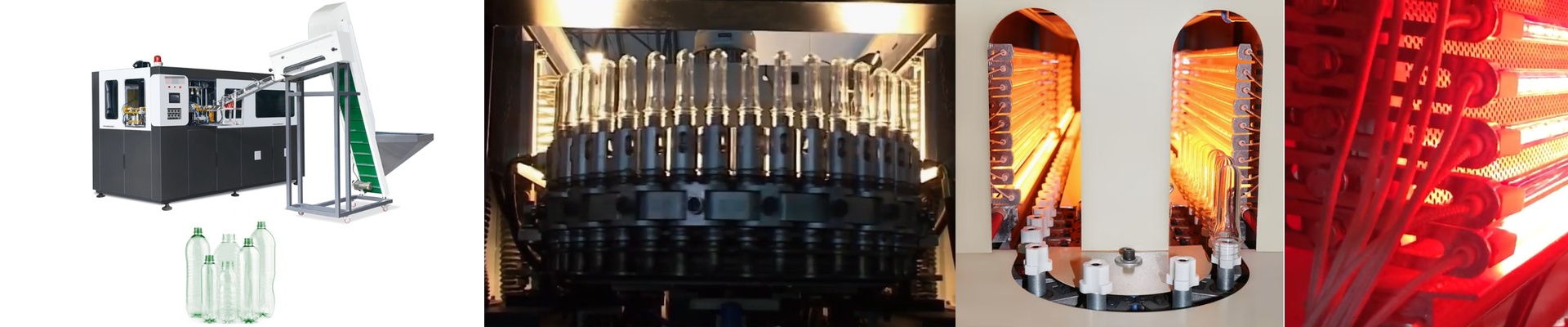
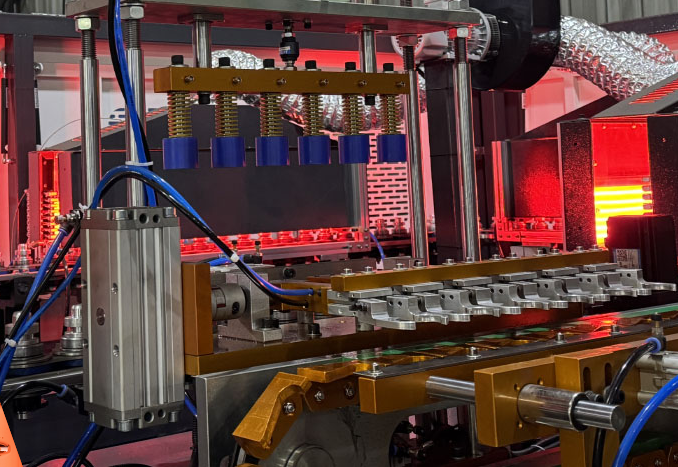
On a blow molding line, the heating tunnel doesn’t negotiate. Preforms have to hit the right temperature profile—every cycle, every shift. When the IR lamps underperform, wall thickness goes sideways, bottles blow out, and the scrap pile grows. When a lamp dies, the machine stops, and downtime is the one thing that scales. If you’re running Sidel, Krones, SIPA, Husky, SACMI, or Nissei ASB blow molders, you need heating that matches the OEM spec. Not “close enough.” The correct wattage. The correct voltage. The right envelope size. The right connector. The right spectral output for PET preform heating. That’s why having a dependable source for wholesale PET blowing IR lamps matters.
What matters under the hood
We supply infrared emitters built for the realities of stretch blow molding—engineered to put stable heat into the preform wall without scorching the surface.
- **Heating approach:**Short-wave IR emitters using halogen or quartz elements. They respond quickly to power changes, giving you tighter control over the heating curve—especially when you’re running multiple preform sizes and colors.
- **Spectral match for PET:**The output is tuned so PET absorbs it efficiently, heating through the wall more evenly. The payoff is fewer hot spots and a more repeatable blowing window.
- **Power and voltage:**Typical blow molding lamps run 1,000–2,000 W, with 120 V or 230 V options depending on the machine and line voltage. We match the OEM rating so the control system sees the expected load.
- **Physical fit:**Lamp length, envelope diameter, and mounting hardware are made to drop into standard heating cassettes and tunnels. Many are built to match common base types like R7s, and the envelope lengths used on Sidel, Krones, SIPA, Husky, SACMI, and Nissei ASB machines.
- **Fast thermal response:**Quartz envelopes heat up quickly, shortening warm-up time and supporting fast-cycle production. That translates into less waiting and more uptime.
- **Focused output:**Reflectors are designed to put energy on the preform, not all over the machine frame. That improves heating uniformity and reduces the heat load on surrounding components.
- **Energy use in real production:**Infrared heating is direct—energy goes where it’s needed. Compared with older, convection-heavy approaches, you can see real reductions in energy per bottle, especially on thin-wall or lightweight designs.
Why this matters on the floor
Blow molding is a repeatability game. The same temperature at the same spot in the heating tunnel, shift after shift. If lamp output drifts, bottle weight drifts. If the lamp takes too long to stabilize, changeovers drag. Our IR lamps are built as drop-in replacements for blow molders from Sidel, Krones, SIPA, Husky, SACMI, and Nissei ASB. That means:
- **OEM-matched specs:**Same wattage, voltage, dimensions, and connector fit. The machine control doesn’t need re-tuning just to make the lamp work.
- **Fewer changeover tweaks:**Because the heating response stays consistent, you spend less time adjusting settings when you switch preforms—especially important when you run a high mix of SKUs.
- **Less scrap, faster recovery:**When a lamp fails, you swap it and get back to production. No long warm-up drift. No extended quality ramp.
- **Predictable maintenance:**We build lamps for industrial duty—tight tolerances, solid seals, and stable output over time. In production, that means you can plan lamp changes instead of chasing failures.
- **Cost control at scale:**When you run multiple machines, buying IR lamps wholesale direct from a China factory cuts out layers of distribution. You get consistent parts, consistent pricing, and one supplier for multiple lines. In practice, that looks like fewer temperature alarms, fewer off-spec bottles, and fewer late-night service calls.
What we see in the field—what to verify before ordering
IR lamps are straightforward to install, but they aren’t plug-and-play if the details are off. Here’s what matters.
- **Spec the lamp, not just the machine.**Blow molders can use different lamp lengths and wattages even within the same platform. Give us the label data from your current lamp—wattage, voltage, length, connector type—and we match it.
- **Check the socket and wiring.**Voltage mismatches and poor contact are a fast track to early failures. Make sure the socket, wiring, and control match the lamp rating.
- **Handle with clean, dry gloves.**Skin oils create hot spots on the quartz envelope. That shortens life and causes uneven heating.
- **Get the reflector and position right.**If the lamp is off-center, preform heating goes uneven and you get asymmetric bottles. Take the minute to verify alignment after installation.
- **Keep the environment in check.**IR lamps are efficient, but they still run hot. Maintain proper airflow and keep the tunnel within the machine’s designed operating window. One practical trade-off: infrared lamps deliver fast, targeted heat, but they’re sensitive to contamination and misalignment. Treat them like precision components, and they’ll perform like it. If you run a blow molding plant, you don’t need promises—you need a heating solution that matches your machines, shows up when you need it, and performs shift after shift. As a China factory supplier specializing in wholesale PET blowing IR lamps, we deliver the specs, the fit, and the reliability you expect from a replacement part engineered for the job. Send us the lamp data from your existing units—wattage, voltage, length, connector, and machine brand—and we’ll get you the right replacement, ready for your line.